Property owners hurt by the new “bird habitat” restrictions on use of private property, other outraged members of the public and some legislators are seeking repeal of the onerous new Maine Department of Environmental Protection rules. Passed by the Legislature last year, the rules were slipped into LD 1981 by Rep. Theodore Koffman (D–Bar Harbor) and DEP Commissioner David Littell without the knowledge of the public or most legislators.
 Koffman, an admitted Audubon director and House chairman of the Natural Resources Committee, and Littell, an enviromentalist Baldacci appointee, are now pushing to seize the agenda and ram through their own “compromise” legislation – legislation that would further expand and entrench state “habitat” control over private property without the nuisance of other bills that might weaken or repeal the state's power. Augusta's collaborators in the press have fully joined their battle and are trying to manipulate public opinion on their behalf.
Of Cats and Kelo
Last Thursday (February 8, 2007) the Bangor Daily News published an inane op-ed arguing for the restrictive habitat overlays, supposedly motivated out of fear of “house cats” wandering the mud flats. The author, a viro university official from North Carolina, wants, in the name of “the economy” no less, to take over other people's private property in Maine for “ecotourists” such as himself – which seemed to be more important to him than his cat phobia. Surely the Kelo eminent domain takings for government – backed private development (see Downeast Coastal Press, February 5–12, 2007) have nothing on this scam.
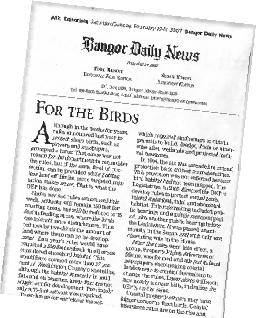
Reading such viro nonsense is enough to make your ears wilt, but it doesn't stop there. Last weekend's (February 10–11, 2007) BDN editorial, titled “For the Birds”, is yet another classic example of the deception and strained logic in the promotions for more power for Augusta on behalf of the Littell and Koffman agenda.
Whitewash and Extortion in the Name of Peaceful “Trade”
“For the Birds” whitewashes the onerous controls over private land use in a new 75 – foot deep restrictive “feeding habitat” overlay, referring to it as if the state land–use controls, prohibitions and fees imposed on top of town zoning were nothing but a traditional zoning “setback” for buildings.
A proposed reduction for some areas from 250 feet to 75 feet – opposed by the viro lobby, which is pushing for more land – is supposed to make the public believe that the effect on private property has been almost entirely eliminated, breathe a big sigh of relief, and believe the DEP has given something up (even in advance of any legislation still subject to viro pressures for additional control).
But behind the cynical divide-and-conquer scheme, people remain trapped in the still extensive 250-foot so-called “roosting” habit overlays. Further, the controls Littell and Koffman want over private land use in both the 75-foot and 250-foot overlays are worse than what they slipped through the first time. The restrictive habitat overlays are much more than building “setbacks” – being more like stringent Resource Protection Zones under another name – and, as always, the DEP powers are subject, under viro pressure, to future expansion in size of targets and in severity of the controls.
Oh, but this is an “exchange,” the BDN tells us with a straight face. Having tried to give the impression that the 75-foot habitat overlays were the equivalent of “setbacks,” “For the Birds” acknowledges additional proposed restrictions prohibiting almost all clearing of any “vegetation” in addition to prohibiting construction. (The DEP intended this all along and has already been imposing it, but Littell and Koffman want it explicit in the law just to make sure no one wiggles out of it with a lawyer contesting their ambiguous powers.) This, the BDN tells us in its Alice-in-Wonderland logic, is an “exchange for shrinking the setbacks,” which it somehow deduces is “a reasonable trade-off.”
“Exchange” with whom and for whose benefit? Who is supposed to be “trading” with whom? The land the viros are wheeling and dealing with belongs to someone else; they never had any right to it in the first place and so it is not theirs to give back for an “exchange” or anything else.
But this is Augusta politics, not the innocent concept of economic trade between consenting traders. Following their massive seizure of private property, Littell and Koffman audaciously propose to give some of it back in “exchange” for even worse restrictions on the remaining land that the viros keep for themselves – and then call this a “reasonable exchange.” Remember that the increased restrictions on personal land use are to apply to both the 250-foot and the 75-foot overlays, that they adversely impact existing homeowners as well as preventing new construction, and that the maps and rules are not static: The viro pressure groups will push them further later. This is their “trade.”
You might think the BDN would be embarrassed to print such nonsense about an alleged “exchange,” but after the “house cat” sophistry apparently anything goes.
This Is “Science”?
The BDN doesn't even want the public to know why the 250-foot habitat restrictions, which were supposedly based on “science,” are now subject to legislative change. The editorial claims that “rules announced last year to protect shore birds ... prompted a furor”; it can't bring itself, in the spirit of honest journalism and open debate, to admit how the rules were “announced” following stealth legislation, and cannot publicly acknowledge that the “furor” is over the state stealing of private property and not over “shore birds.”
“For the Birds” insinuates the reason for the “department to reconsider the rules” is for more intense, “more-targeted regulations,” not “the furor” and the resulting possibility of the Legislature rescinding the rules the DEP slipped by it. It's all “For the Birds.”
Nor is there any mention of why this obviously politically manipulated mess that somehow previously “scientifically” required taking exactly 250 feet of private property near the shore now requires taking “only” 75 feet. What happened to Littell's insistence last year at the Addison meeting that the original rules were all based on “sound science”? And whatever happened to a previous Maine Department of Inland Fisheries and Wildlife (DIFW) comprehensive internal report concluding that existing shore-land zoning was adequate for bird “protection,” and that it is not practical to impose additional habitat overlay restrictions on the uplands? It seems that that report was easier to ignore since it was not supposed to be seen by the public. Yup, it's all “science.”
Besides, the DIFW would have to publicly acknowledge that the report concluded that “disturbance” from water activities is far more than from homes on the shore, which means the agency wants to go after traditional docks, wharfs, clamming, hunting, fishing and boating next. No wonder they are worried about a house cat getting out of the bag.
Revisionist History
As for more political manipulations, the editorial also includes the now standard, sanitized and inaccurate revisionist history of the evolution of the habitat rules under the Natural Resources Protection Act (NRPA); it's the official line adapted by the Baldacci administration and repeated over and over by Littell and Koffman – and their press agents at the BDN.
Completely omitted from the account is last year's sneak attack, as Koffman and Littell slipped a major substantive rule change and maps requiring legislative approval through the legislature without telling either the legislators or the property owners what they were doing. In truth, the covert action was only the latest unfolding of an incrementalist, multi-step strategy to quietly build anti-property rights provisions into the law (the NRPA in this case), which could not be done all at once.
The restrictive bird habitat agenda – which would have been too controversial to be implemented as legislatively approved rules when first put in the NRPA years ago and which almost no one knew about – was intended to be sprung into implementation years later with new rules and maps authorizing their implementation long after anyone could remember how it got in the NRPA in the first place. New implementing rules with maps were of course intended all along by the insiders and of course were also snuck through (last spring) before anyone could see them coming.
The intended effect of the Littell/Koffman/BDN revisionist history is to get people to believe that nothing new has happened; that the controls over private property are long established, accepted and should be immune from criticism – as if the latest maneuver were only a matter of a few details of something commonly accepted. The viros know better, but that is what the public is supposed to believe.
Climate Change Hysteria
But the BDN “For the Birds” sophistry doesn't end even there. The editorial wanders off to a completely irrelevant topic. Politicizing the weather, it resurrects the obligatory viro “climate change” hysteria, warning that insurance companies will no longer cover homes on the Maine coast because of “increasing losses from hurricanes and other storms.” You are supposed to believe that none of this habitat controversy matters compared to “real” threats as identified by the all-knowing viros. No one should be on the shore anyway so everyone should stop bothering to protest the viro habitat takings.
Never mind that hurricanes rarely make it up to New England and the few that do make it this far north normally follow the warmer water in the Gulf Stream east of Nova Scotia, far from the Maine coast. Never mind that most of the rocky Maine coast is unusually well protected compared with other coastal states. And never mind that companies insuring homes – as well as medical care or everything else – and most other industries for that matter, are being driven out of Maine not by “storms” but because of Maine's third world-style taxes and controls.
This Is “Reasonable”?
If you can take any more of this, we still need to look at the editorial's concluding words. After the run-on barrage of viro habitat sophistry completely ignoring the rights of property owners, it concludes with the usual gratuitous but loudly promoted viro characterization of itself as “reasonable,” claiming to support “reasonable development while being as protective of habitat as possible.”
This means in practice of course that “habitat” comes first and “reasonable development” is whatever the viros say it is, i.e., is whatever is left that viros are willing to permit, which evidently includes nothing else on the coast. This includes land along rivers, streams, ponds, lakes and “wetlands,” to say nothing of seasonal “vernal pool” mud puddles. For ideological viros, private property is “For the Birds.” But the public is only supposed to believe, through repetitious insistence and without looking too closely, that the viros are being “reasonable.”
But you also know that when viros repeatedly and publicly emphasize empty slogans on how “reasonable” they are, in addition to conning the public into submission, it means that they aren't getting what they really want out of what they call a “compromise” and will be back for the rest later. Viro lobbyists are currently pushing for bigger habitat overlay areas, but for now their main goal is to establish in law the premise that they have the power to completely control private property that they declare to be “habitat”; they plan to be back later to litigate and lobby to expand the boundaries, the controls, and the kinds of “habitat” that can be designated.
It's strategically too soon for viro activists to let the house cat out of the bag by explicitly revealing everything they are after because the public isn't yet ready for it, but their actions and their sophistry already reveal that, to them, property rights are nothing but a temporary political obstruction to their ideological goal of complete bureaucratic social control, any way they can get it.
Copyright © 2007 Erich Veyhl, All rights reserved
More on the “habitat” land control agenda for Maine: www.moosecove.com/propertyrights/index.shtml#habitat